Structured data for AI search helps clarify meaning—not guarantee visibility. While it won’t force inclusion in AI answers or citations, correctly implemented structured data can reduce ambiguity, reinforce entity understanding, and align your content with how AI systems interpret pages. This guide explains which schema types matter, how to implement them safely, and how structured data fits into a complete Generative Engine Optimization (GEO) system.
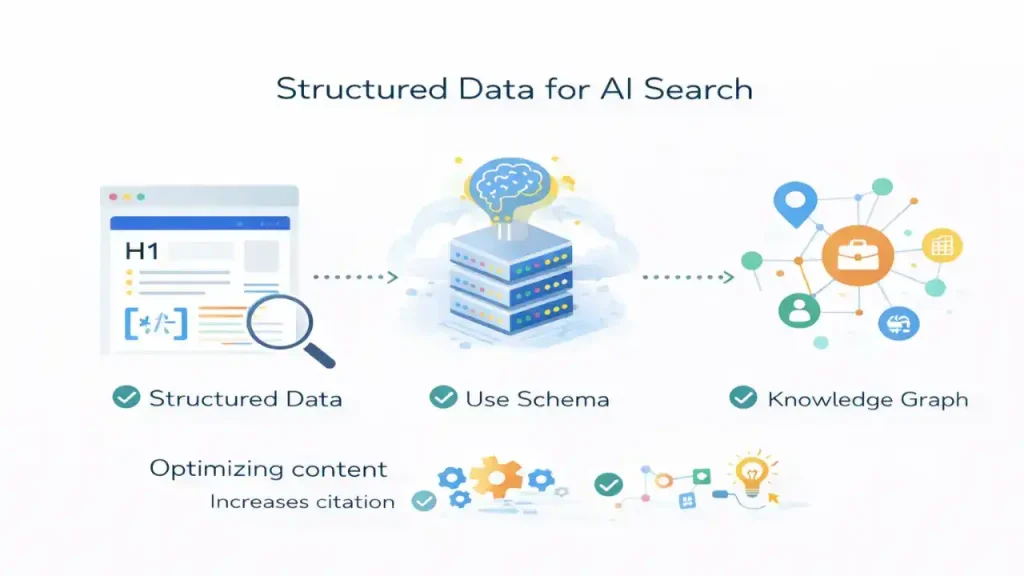
What Structured Data Actually Does for AI Search
Structured data provides explicit signals about:
- Content type (article, FAQ, how-to)
- Entities (organization, person, product)
- Relationships between entities
For AI-driven search and answer engines, this helps:
- Disambiguate concepts
- Validate page intent
- Align machine-readable signals with visible content
Key reality: Structured data supports clarity; it does not replace quality content, entity trust, or strong structure.
Structured Data vs Rankings vs AI Citations
- Rankings: Structured data does not directly boost rankings.
- AI Overviews: It can improve eligibility by reinforcing page type and intent.
- AI Citations: It can support consistency when the content itself is citable.
Structured data is a supporting layer, not a shortcut.
Schema Types That Matter Most for AI Search
1) Article / BlogPosting
Use for:
- Educational guides
- Pillar pages
- In-depth explanations
Why it helps: Clarifies authorship, publication dates, and topical focus.
2) FAQPage
Use when:
- FAQs are visible on the page
- Each question has a clear, concise answer
Why it helps: Aligns well with conversational queries and AI extraction patterns.
Rule: Only mark up FAQs that are actually visible to users.
3) HowTo
Use for:
- Step-by-step instructions
- Procedural content
Why it helps: Reinforces instructional intent and step order.
Avoid if:
- Steps are vague
- Content is more conceptual than procedural
4) Organization and Person
Use to:
- Define brand identity
- Strengthen author entities
Why it helps: Supports Entity SEO for AI Search by clarifying who produces the content.
5) Product (Selective)
Use only when:
- The page is genuinely about a specific product
- Information is factual and verifiable
Avoid using Product schema on generic informational pages.
Schema Types That Often Don’t Help
- Overly generic markup with little visible content
- Misused Product or Review schema on informational pages
- Hidden or auto-generated structured data
- Markup that adds facts not present on the page
Misuse creates trust issues and can harm overall clarity.
Implementation Best Practices
Match Visible Content Exactly
Structured data must reflect what users can see.
- No extra claims
- No hidden answers
- No inflated attributes
Mismatch increases the risk of being ignored.
Keep It Minimal
Use only the schema types that clearly apply.
- One primary content type per page
- Supporting schemas only when justified
Over-marking creates noise.
Maintain Canonical Discipline
Each canonical page should:
- Have one clear schema focus
- Avoid conflicting markup across duplicates
This helps AI systems consolidate understanding.
Structured Data and AI Overviews
Structured data alone will not trigger AI Overviews, but it can:
- Reinforce that a page is a how-to, FAQ, or explanation
- Reduce ambiguity when multiple pages compete
- Support accurate extraction when the content is selected
Combine it with:
- Direct answers
- Clear headings
- Fresh, accurate content
Structured Data and Perplexity / LLM Citations
For citation-first engines:
- Structured data supports consistency, not discovery
- It helps confirm page type and authorship
- It cannot compensate for vague or promotional writing
Clarity in the text remains the deciding factor.
Testing and Validation
Before publishing:
- Validate schema using testing tools
- Check for errors and warnings
- Confirm alignment with visible content
After publishing:
- Monitor Search Console enhancements (where applicable)
- Ensure no manual actions or warnings appear
Testing ensures signals are clean and trustworthy.
Internal Linking That Reinforces Structured Signals
Internal links help structured data do its job by:
- Pointing AI systems to canonical hubs
- Reinforcing topic hierarchy
Recommended links:
- Up to Generative Engine Optimization (GEO) for context
- To Entity SEO for AI Search for identity grounding
- To AI Overviews Optimization for execution alignment
Avoid adding links solely for schema validation.
Common Structured Data Mistakes
- Marking up content that isn’t visible
- Using multiple conflicting schemas on one page
- Adding claims not supported by the text
- Treating schema as a ranking tactic
- Forgetting to update schema when content changes
These errors reduce trust and usefulness.
How Structured Data Fits Into the GEO System
Within a GEO framework:
- GEO defines the strategy
- LLMO defines how content is written
- Citation optimization defines reuse
- Structured data reinforces clarity
- Entity SEO builds trust
- Visibility tracking measures outcomes
Structured data strengthens what’s already working; it does not fix weak fundamentals.
Frequently Asked Questions
Do I need structured data for AI search?
No. Many pages appear in AI answers without it. Structured data is optional but helpful for clarity.
Can structured data increase AI citations?
Indirectly. It supports consistency and entity understanding, which can improve citation reliability when content is already citable.
Should every page use schema?
No. Use schema only when it accurately represents the page content.
Structured data enhances clarity, but it cannot fix poor writing. Creating AI-readable content ensures that explanations are understandable, extractable, and reusable by AI systems.
Final Thoughts
Structured data for AI search is about alignment, not manipulation. When your content is clear, trustworthy, and well-structured, schema can reinforce those signals and reduce ambiguity for AI systems.
As part of a complete Generative Engine Optimization (GEO) system—alongside LLMO, entity SEO, and citation optimization—structured data helps ensure your content is understood exactly as you intend it to be.