Perplexity citations optimization focuses on increasing the likelihood that your content is selected, referenced, and consistently cited inside Perplexity’s answers. Because Perplexity is a citation-first engine, success depends on clarity, extractability, and entity trust—not classic rankings alone.
This guide explains what makes a page citable in Perplexity, how to structure content for reliable reuse, and how to refine your approach within a complete Generative Engine Optimization (GEO) system.
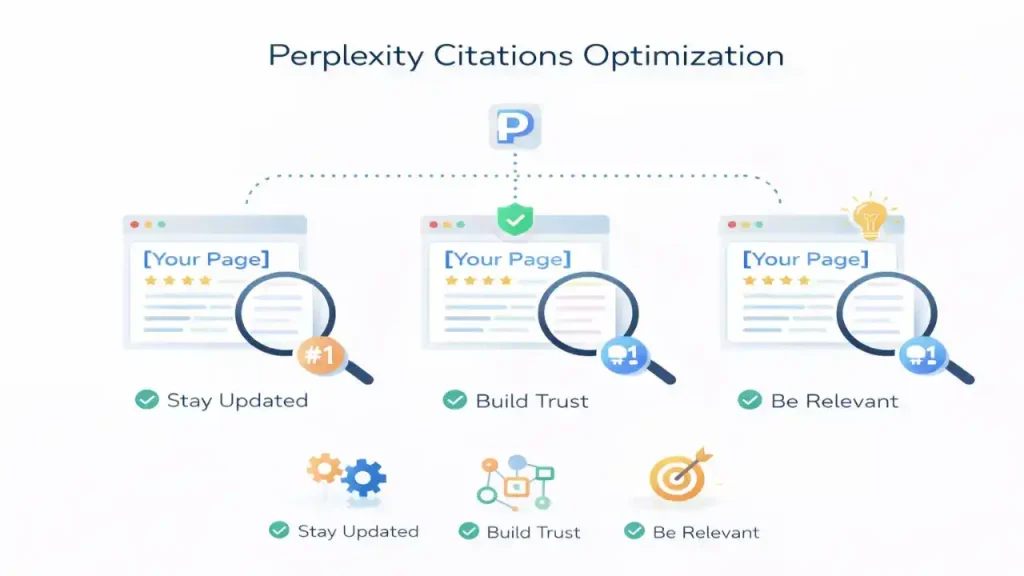
What Makes a Source Citable in Perplexity
Perplexity prioritizes sources it can safely reference. Pages are more likely to be cited when they demonstrate:
- Direct answers that resolve the query quickly
- Neutral, instructional tone (not promotional)
- Clear structure that supports extraction
- Consistency across related pages
- Recognizable entity signals (brand, author, topical focus)
Citations reward reliability, not hype.
The Core Citation Signals Perplexity Uses
1) Definition-First Content
Begin key sections with a one-sentence definition or answer that can stand alone.
Why it works: It minimizes ambiguity and reduces the risk of misquoting.
2) Section-Level Independence
Perplexity often extracts information at the section level.
Each H2/H3 should:
- Answer one question
- Avoid relying on prior context
- Use consistent terminology
3) Factual Precision With Constraints
State:
- What is true
- When it applies
- When it does not
Pages that acknowledge limits are safer to cite than pages that overpromise.
4) Structured Comparisons
Use tables or bullet lists for comparisons:
- Attributes
- Differences
- Use cases
Structured comparisons are easier to verify and reuse.
5) Entity Trust and Consistency
Perplexity prefers sources tied to a clear entity:
- Consistent brand/topic coverage
- Stable authorship
- Canonical pages for core concepts
This is why Entity SEO for AI Search is a prerequisite for reliable citations.
How to Structure Pages for Perplexity Citations
Headings That Match Real Questions
Use headings that mirror how users ask questions. Avoid clever or abstract titles.
Short Paragraphs, One Idea Each
Dense paragraphs increase interpretation risk. Keep paragraphs concise and focused.
Minimal Internal Cross-References
Avoid phrases like “as discussed earlier.” Each section should read cleanly in isolation.
Tables Over Narratives for Data
If you can show it in a table, do so.
Writing Patterns That Increase Citation Frequency
Definition → Explanation → Constraints
This mirrors how Perplexity composes answers.
Step-by-Step (When Applicable)
Numbered steps with plain language are easy to extract and reproduce accurately.
FAQ Blocks
FAQs align with conversational prompts and are frequently cited verbatim or paraphrased.
Internal Linking That Supports Citations
Internal links should reinforce topical hierarchy—not distract.
Recommended pattern:
- Link up to the Generative Engine Optimization (GEO) pillar for context
- Link to How to Rank in Perplexity for discovery mechanics
- Link to Entity SEO for AI Search for authority grounding
Avoid excessive lateral links that dilute page focus.
Technical Foundations for Citation Reliability
Crawlable, Text-First Content
- Ensure explanations are visible in rendered HTML
- Avoid hiding key content behind scripts or gated UI
Canonical Discipline
- One canonical URL per concept
- No competing pages with different explanations
Structured Data (Supportive, Not Required)
Structured data can reinforce clarity when it matches visible content exactly. It does not guarantee citations.
Measuring Citation Presence in Perplexity
Perplexity does not provide publisher analytics, so measurement relies on consistent observation:
- Manual checks for your domain in citations
- Tracking brand/domain mentions
- Monitoring impressions growth for informational queries
- Evaluating engagement quality from AI-referred traffic
Look for consistency over time, not one-off mentions.
Common Reasons Pages Fail to Get Cited
- Vague or opinion-heavy language
- Mixed intents on a single page
- Promotional tone or affiliate framing
- Inconsistent terminology across pages
- Weak entity or author signals
Fixing these issues often increases citation frequency without additional content.
How This Page Fits Into the GEO System
Within a Generative Engine Optimization (GEO) strategy:
- GEO defines the framework
- LLMO explains how models read content
- ChatGPT citations optimization targets reuse
- Perplexity citations optimization refines source selection
- Structured data and entity SEO reinforce trust
- Visibility tracking validates outcomes
Each layer compounds the next.
Frequently Asked Questions
Can small sites be cited by Perplexity?
Yes. Focused, precise explanations from small sites are frequently cited when they are clearer than larger competitors.
Do backlinks determine Perplexity citations?
They can help authority, but clarity, structure, and entity trust matter more for citation selection.
How often should I update citable pages?
Update when facts change, examples age, or competitors improve clarity. Consistency matters more than frequency.
Citation consistency improves when content signals are clear. Implementing structured data for AI search can support clarity by reinforcing content type, relationships, and context.
Final Thoughts
Perplexity citations optimization is about being the safest source to reference. When your content is precise, structured, and entity-aligned, Perplexity can cite it confidently and repeatedly.
Combined with How to Rank in Perplexity, Entity SEO, and the broader GEO content system, this approach transforms your site from a passive index entry into an active reference inside citation-first AI answers.