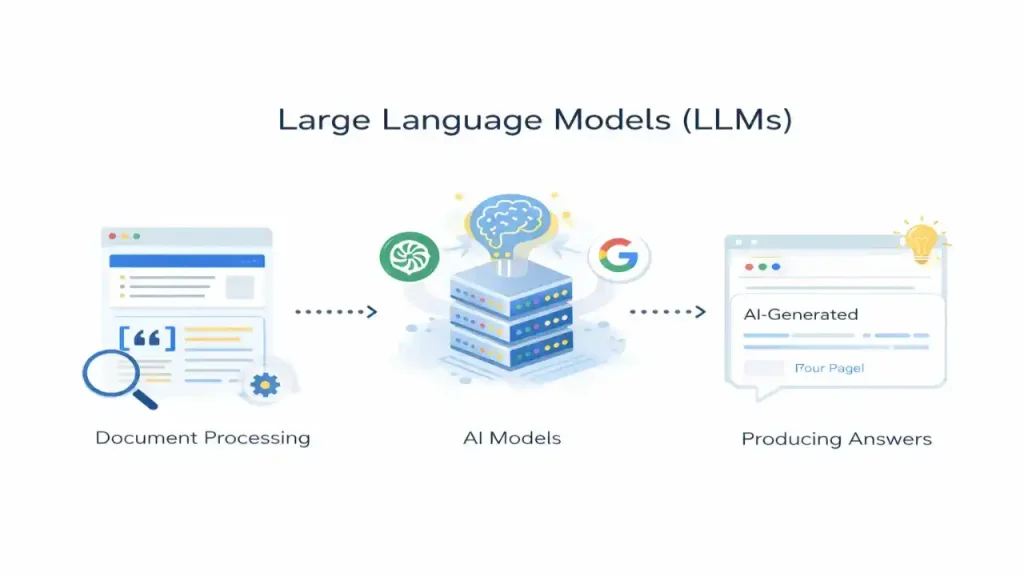
llms.txt is a proposed, lightweight text file intended to help large language models (LLMs) understand what content on a site is meant for AI consumption and how it should be treated. It is not a ranking factor, not an official Google requirement, and not a guaranteed way to influence AI answers. Used correctly, it can provide clarity signals within a broader Generative Engine Optimization (GEO) system. Used incorrectly, it adds no value.
This guide explains what llms.txt is, how it works, when it helps, and—just as important—when it does not.
What Is llms.txt?
llms.txt is a simple, human-readable text file placed at the root of a website (e.g., example.com/llms.txt). Its purpose is to describe how AI systems should interpret and use site content, typically by pointing to canonical resources, summaries, or preferred entry points.
Key characteristics:
- Plain text
- Non-executable
- Voluntary and non-binding
- Readable by humans and machines
llms.txt does not replace:
- robots.txt
- meta robots directives
- canonical tags
- structured data
It is best understood as an informational hint, not a control mechanism.
How llms.txt Works (Conceptually)
LLMs and AI answer engines gather information from the web using a mix of crawling, retrieval, and licensed data. Where supported, llms.txt can:
- Point to authoritative pages (pillars, hubs)
- Clarify scope and intent of content
- Reduce ambiguity about which pages represent the “official” explanation
Importantly, LLMs are not required to follow llms.txt, and support varies by platform. Some systems may read it; others may ignore it entirely.
llms.txt vs robots.txt vs meta directives
robots.txt
- Controls crawling access
- Enforced by compliant crawlers
- Can block content entirely
Meta robots (noindex, nofollow)
- Control indexing and link following
- Enforced within search engines
llms.txt
- Provides context and guidance
- Does not block or enforce
- Offers no guarantee of compliance
Conclusion: llms.txt is advisory; robots and meta directives are authoritative.
When llms.txt Can Be Helpful
1) Large, Complex Sites
For sites with many pages, llms.txt can help AI systems identify:
- Core hubs
- Canonical explanations
- Preferred summaries
This reduces the chance that peripheral or outdated pages are used as primary sources.
2) Clear Content Systems (Clusters)
If your site is organized into well-defined content systems (like a GEO cluster), llms.txt can point AI systems to:
- The main pillar page
- Supporting guides
- Measurement or reference pages
This aligns with LLMO goals of improving comprehension and citation accuracy.
3) Reducing Misinterpretation Risk
When multiple pages discuss similar topics, llms.txt can clarify:
- Which page is the authoritative reference
- Which pages are supplementary
This helps prevent inconsistent or partial summaries.
When llms.txt Does NOT Help
It does not:
- Improve rankings
- Force citations
- Replace quality content
- Override blocked or hidden pages
- Compensate for weak structure or unclear writing
If your content is vague, duplicated, or poorly organized, llms.txt will not fix it.
How to Structure llms.txt (Best Practice)
Keep it simple and conservative. A typical structure includes:
- A short site description
- Links to key hubs or pillar pages
- Notes about content scope or audience
- Optional links to summaries or documentation
Example (conceptual)
Site: Example.com
Purpose: Educational content about AI search and optimization.
Primary resources:
- /generative-engine-optimization/
- /how-to-appear-in-google-ai-overviews/
- /large-language-model-optimization/
Notes:
- Content is informational and updated regularly.
- Pillar pages represent canonical explanations.
Avoid:
- Promotional language
- Claims about rankings
- Instructions that contradict robots/meta rules
Placement and Technical Considerations
- File path:
https://example.com/llms.txt - Content type:
text/plain - Publicly accessible
- No scripts or redirects
Do not link llms.txt from site navigation. It is meant for systems, not users.
Internal Linking Still Matters More
Even with llms.txt:
- Clear internal linking is essential
- Pillar pages should receive the most internal authority
- Supporting pages should link back to the hub
llms.txt supplements internal structure; it does not replace it.
Measuring Impact (Realistically)
There is no direct metric for llms.txt effectiveness. Possible indirect indicators:
- More consistent AI summaries
- Reduced use of outdated pages in AI answers
- Improved citation accuracy over time
Changes should be evaluated cautiously and over long periods.
Common Mistakes With llms.txt
- Treating it as a ranking tool
- Using marketing or persuasive language
- Listing too many pages
- Pointing to non-canonical or thin content
- Expecting immediate or measurable results
These mistakes create false expectations and add no value.
How llms.txt Fits Into the GEO System
Within a Generative Engine Optimization (GEO) strategy, llms.txt sits in the supporting technical layer:
- GEO pillar defines the system
- LLMO defines how content is written
- ChatGPT citation optimization defines formatting
- llms.txt provides optional context
- Entity SEO and Perplexity optimization build authority
Each layer depends on the others.
Frequently Asked Questions
Is llms.txt required for GEO or LLMO?
No. It is optional and should only be used when your content system is already strong.
Does Google use llms.txt?
There is no official confirmation that Google relies on llms.txt for AI Overviews or ranking.
Can llms.txt harm my site?
Not directly, but poor usage can create confusion if it contradicts canonical structure or content quality.
While llms.txt can clarify content intent, it does not replace foundational trust signals. Long-term visibility still depends on Entity SEO for AI Search, which establishes consistent authority across topics and pages.
Final Thoughts
llms.txt is not a shortcut. It is a small, optional signal that can help clarify your site’s structure for AI systems—if your content is already clear, authoritative, and well-organized.
In a mature GEO and LLMO strategy, llms.txt should be treated as a supporting document, added only after fundamentals are in place. Focus first on clarity, structure, and credibility. Only then does llms.txt make sense as a final layer of guidance.