Large Language Model Optimization (LLMO) is the practice of structuring, writing, and maintaining content so it can be accurately understood, selected, summarized, and cited by large language models (LLMs) such as ChatGPT, Gemini, Claude, and Perplexity. While traditional SEO focuses on ranking pages, LLMO focuses on becoming a reliable source inside AI-generated answers.
LLMO is a core component of Generative Engine Optimization (GEO) and extends visibility beyond Google’s AI features into conversational and citation-based answer engines.
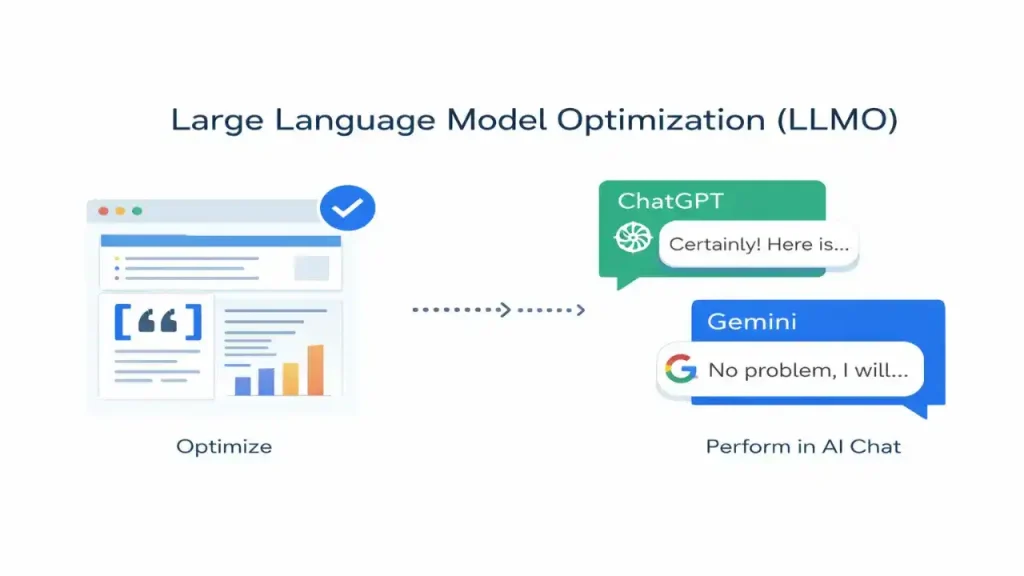
What Is Large Language Model Optimization (LLMO)?
LLMO is the process of optimizing content for how language models consume, compress, and reproduce information. These models do not “rank pages” in the traditional sense. Instead, they:
- Learn patterns from large text corpora
- Retrieve or reference sources when answering questions
- Prefer content that is clear, consistent, and factually grounded
LLMO ensures your content is:
- Easy to parse at the sentence and section level
- Precise enough to avoid hallucation
- Structured in a way that supports citation and summarization
How LLMs Consume Web Content
Understanding LLM behavior is essential before optimizing.
Token-Based Understanding
LLMs process text as tokens and patterns, not as pages or layouts. This makes:
- Sentence clarity
- Terminology consistency
- Logical flow
critical for accurate interpretation.
Context Compression
When generating answers, LLMs compress multiple sources into short summaries. Content that is:
- Redundant
- Vague
- Overly promotional
is more likely to be ignored or misrepresented.
Source Selection
When citations are shown (as in Perplexity or some AI answers), LLMs favor:
- Explicit definitions
- Step-by-step explanations
- Pages with clear topical focus
- Content aligned with recognized entities
LLMO vs GEO vs Traditional SEO
Traditional SEO
- Targets rankings and clicks
- Optimizes for keywords and backlinks
- Measures success by position and CTR
GEO
- Targets AI-generated search features
- Optimizes for extractability and structure
- Measures success by impressions, coverage, and qualified clicks
LLMO
- Targets language models directly
- Optimizes for comprehension, accuracy, and citability
- Measures success by visibility inside AI answers and citations
LLMO does not replace SEO or GEO—it depends on both to function effectively.
Core Principles of LLMO
1) Write for Comprehension, Not Discovery
LLMs reward content that explains concepts cleanly:
- One idea per paragraph
- Definitions stated explicitly
- Minimal ambiguity
Avoid metaphor-heavy or opinion-first writing.
2) Maintain Terminology Consistency
Use one primary term per concept and stick to it.
- Avoid unnecessary synonyms
- Reintroduce definitions when context changes
This reduces misinterpretation during summarization.
3) Prefer Explicit Structure
LLMs extract information more reliably from:
- Clear H2/H3 sections
- Numbered steps
- Bullet-point constraints
- Tables for comparisons
Structure reduces hallucation risk.
4) State Constraints and Limits
High-quality LLM-friendly content explains:
- When advice applies
- When it does not
- Edge cases and exceptions
This improves trust and citation likelihood.
5) Support Entity Recognition
LLMs rely heavily on entities:
- Brands
- People
- Concepts
- Technologies
Make entity relationships explicit:
- Define what your site covers
- Clarify your topical scope
- Reinforce expertise signals consistently
Writing Patterns That Perform Best in LLMs
Definition-First Pattern
Start sections with a one-sentence definition, then expand.
Problem → Solution → Conditions
This mirrors how LLMs assemble explanations.
Step-by-Step Instructions
Numbered steps with short descriptions are easier to reproduce accurately.
FAQ-Driven Coverage
FAQs align well with conversational queries and are frequently reused in AI answers.
Citability: The Hidden Goal of LLMO
LLMs are more likely to reference content that:
- States facts clearly
- Separates facts from opinion
- Uses neutral, instructional language
- Avoids exaggerated claims
Citability increases when content:
- Is specific
- Is verifiable
- Uses consistent phrasing across pages
This is why LLMO pairs closely with Entity SEO for AI Search and How to Optimize Content for ChatGPT Citations within the GEO system.
Technical Factors That Support LLMO
Crawlable, Text-First Content
- Ensure core content is visible in rendered HTML
- Avoid hiding key explanations behind scripts or gated components
Canonical Clarity
- One URL per primary concept
- Avoid duplicate explanations across multiple pages
Internal Linking for Context
Internal links help reinforce topical boundaries:
- Link up to the Generative Engine Optimization (GEO) pillar for context
- Link down to execution guides (citations, entity SEO) only when relevant
Measuring LLMO Impact
LLMO success is rarely visible through traditional “rankings.”
Early indicators include:
- Broader query coverage
- Increased impressions without equivalent click growth
- Appearance as a cited or referenced source in AI tools
- Higher engagement quality from AI-referred traffic
LLMO measurement is addressed in detail in the AI Search Visibility Tracking guide within this content system.
Common LLMO Mistakes
- Writing vague, opinion-heavy content
- Using inconsistent terminology across pages
- Targeting multiple unrelated intents on one page
- Over-optimizing with unnatural keyword repetition
- Lacking author or topical credibility signals
These reduce both accuracy and trust.
LLMO Implementation Sequence
To apply LLMO effectively:
- Establish a strong GEO pillar
- Optimize for Google AI Overviews
- Implement LLMO fundamentals (this guide)
- Apply ChatGPT citation optimization
- Strengthen entity-level authority
- Measure and refine based on visibility signals
Frequently Asked Questions
Is LLMO only relevant for AI tools like ChatGPT?
No. LLMO applies to any system that uses large language models to generate answers, including AI search features and citation-based engines.
Does LLMO require special markup or files?
No special markup is required. Clear content, strong structure, and technical accessibility matter far more.
How long does LLMO take to show results?
Like SEO, LLMO shows early signals through impressions and coverage before clear traffic patterns emerge.
Final Thoughts
Large Language Model Optimization is about precision, clarity, and trust. As AI-generated answers become a primary interface for discovery, content that is easy for language models to understand—and safe to reuse—will consistently outperform content written only for rankings.
When implemented as part of a broader Generative Engine Optimization (GEO) system, LLMO positions your site not just to be found, but to be used as a source in the AI-driven future of search.