Ranking in Perplexity is fundamentally different from ranking in traditional search engines. Perplexity is a citation-first answer engine: it generates responses by synthesizing information and explicitly citing sources it trusts. Visibility depends less on classic rankings and more on citability, clarity, and entity trust.
This guide explains how Perplexity works, what it looks for in sources, and how to optimize content so your pages are selected, cited, and reused consistently—within a complete Generative Engine Optimization (GEO) system.
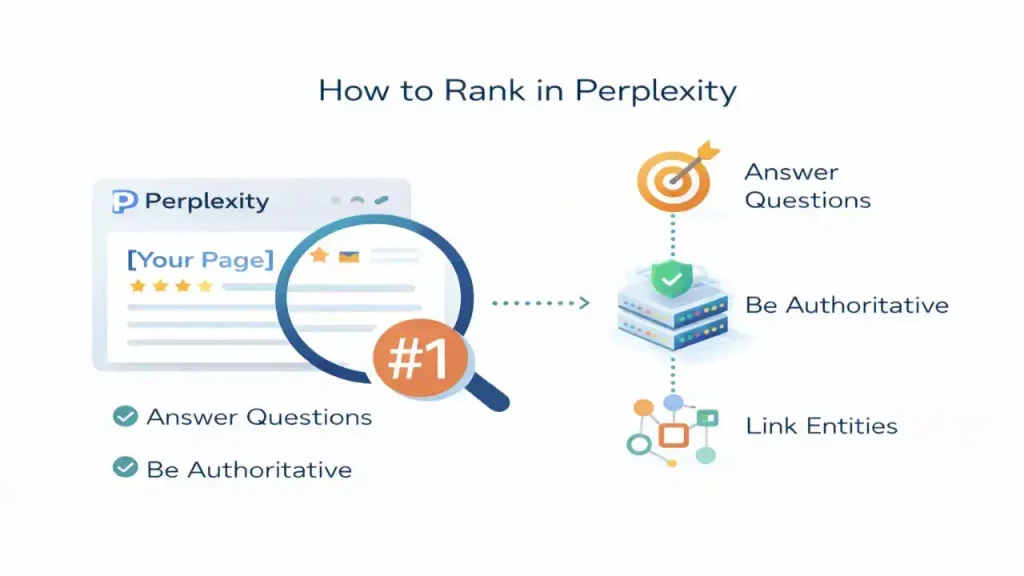
How Perplexity Works
Perplexity answers questions by:
- Interpreting user intent
- Retrieving relevant sources
- Generating a synthesized answer
- Displaying citations to the sources used
Because citations are central to its experience, Perplexity prioritizes sources that are:
- Clear and factual
- Easy to extract
- Consistent across pages
- Associated with recognizable entities
Perplexity does not rely on a traditional SERP ranking model; instead, it selects sources it can safely reference.
What Perplexity Looks for in Sources
Clear, Direct Answers
Pages that answer questions directly—without long introductions—are easier to cite accurately.
Best-performing content:
- Defines concepts explicitly
- Answers the query early
- Expands with supporting detail
Structured, Extractable Content
Perplexity favors content that can be summarized reliably:
- Headings that reflect real questions
- Short paragraphs
- Lists and tables
- FAQs with concise answers
Ambiguous or narrative-heavy content is harder to reuse.
Topical Focus
Each page should target one primary intent:
- Definition
- How-to
- Comparison
- Explanation
Pages covering multiple unrelated intents dilute relevance and reduce citation likelihood.
Entity Trust Signals
Perplexity is more likely to cite sources that:
- Represent a clear brand or author entity
- Cover topics consistently over time
- Demonstrate subject-matter focus
This is why Entity SEO for AI Search is a prerequisite for consistent Perplexity visibility.
Optimization Checklist for Ranking in Perplexity
1) Write for Citation, Not for Clicks
Perplexity users already see a synthesized answer. They click sources to:
- Verify information
- Explore details
- Access deeper explanations
Optimize pages to be reference-quality, not promotional.
2) Use Definition-First Sections
Begin key sections with a one-sentence definition or answer that can stand alone.
This reduces the risk of misquotation and improves citation accuracy.
3) Prefer Tables and Lists for Comparisons
Perplexity frequently cites pages that:
- Compare options clearly
- Use tables for attributes and differences
- Avoid subjective scoring without explanation
4) Include Constraints and Context
Explain:
- When advice applies
- When it does not
- Edge cases or limitations
This increases trust and reuse.
5) Maintain Canonical Pages
Avoid publishing multiple pages that explain the same concept differently.
Perplexity prefers:
- One clear canonical source
- Supporting pages that expand, not compete
Internal Linking That Supports Perplexity Ranking
Internal links help Perplexity and similar systems understand topical hierarchy.
Recommended structure:
- Link up to the Generative Engine Optimization (GEO) pillar for context
- Link to Entity SEO for AI Search for authority grounding
- Avoid excessive lateral links that blur page intent
Internal consistency improves source selection.
Technical Foundations That Matter
Crawlable, Text-First Pages
Ensure that:
- Core explanations are visible in HTML
- Content is not hidden behind scripts
- Pages load reliably and consistently
Clean URL and Canonical Signals
- One URL per primary topic
- Correct canonical tags
- No conflicting versions of the same explanation
Structured Data (Supportive Only)
Structured data can help clarify content type, but it does not guarantee citation. It must reflect visible content exactly.
Measuring Visibility in Perplexity
Perplexity does not provide publisher analytics, so measurement relies on indirect signals:
- Manual checks for citations of your pages
- Monitoring brand or domain mentions
- Increased impressions for informational queries
- Higher engagement from AI-referred traffic
Consistency over time matters more than short-term fluctuations.
Common Reasons Pages Don’t Rank in Perplexity
- Vague explanations without definitions
- Promotional or biased language
- Mixed intents on a single page
- Weak or inconsistent entity signals
- Duplicate or competing content
Fixing these issues often leads to improved citation frequency.
How This Page Fits Into the GEO System
Within a Generative Engine Optimization (GEO) strategy:
- GEO defines the overall framework
- LLMO explains how models consume content
- ChatGPT citation optimization focuses on reuse
- How to Rank in Perplexity targets citation-first engines
- Perplexity citations optimization refines execution further
Each layer reinforces the others.
Frequently Asked Questions
Does Perplexity crawl the web like Google?
Perplexity retrieves information from multiple sources and databases, but it does not operate like a traditional crawler-based search engine.
Do backlinks matter for Perplexity?
They can support overall authority, but clarity, structure, and entity trust are more important for citation.
Can small websites rank in Perplexity?
Yes. Smaller sites with focused, high-quality explanations are often cited when they provide the clearest answers.
Final Thoughts
Ranking in Perplexity is about becoming a reliable reference, not chasing positions. The clearer, more structured, and more trustworthy your content is, the easier it is for Perplexity to cite and reuse it.
When combined with Entity SEO, LLMO, and a cohesive GEO content system, Perplexity becomes a powerful visibility channel—one that rewards precision, depth, and consistency over traditional ranking tactics.