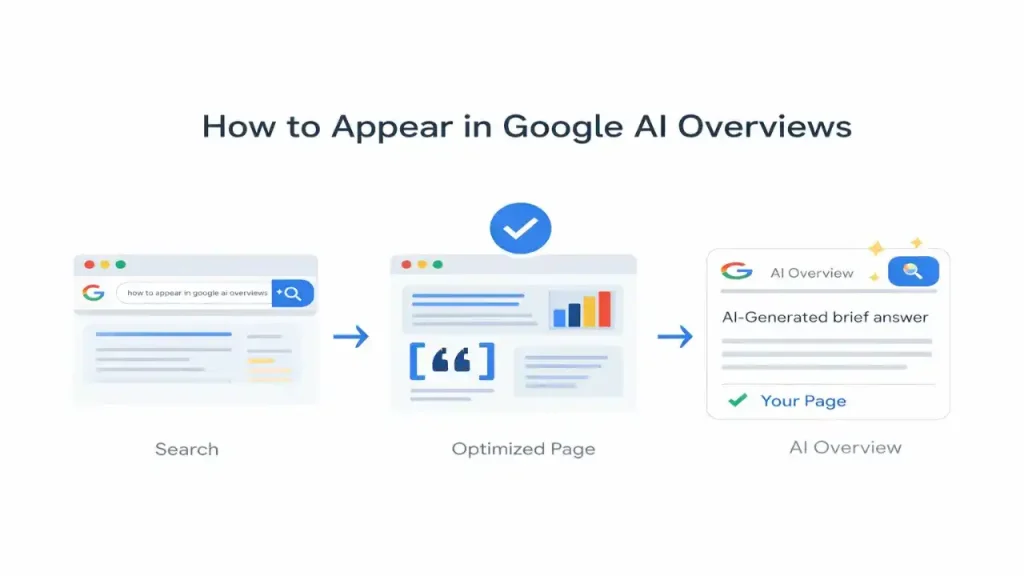
Appearing in Google AI Overviews means your content is selected, summarized, and sometimes cited within Google’s AI-generated answers. This is not a replacement for traditional rankings—it’s an additional visibility layer that rewards clarity, structure, and trust. This guide explains how AI Overviews work, what Google looks for, and the exact steps you can take to improve your chances of inclusion.
What Are Google AI Overviews?
Google AI Overviews are AI-generated summaries shown directly in search results for eligible queries. They aim to answer questions quickly by combining information from multiple trusted sources, with links or citations to supporting pages.
AI Overviews typically appear for:
- Definitions and explanations
- How-to and instructional queries
- Comparisons and evaluations
- Broad informational searches
Inclusion depends on relevance and extractability, not on a single ranking factor.
How Google Selects Content for AI Overviews
Google’s AI features rely on a combination of SEO fundamentals and content characteristics that make information easy to understand and verify.
Answer Clarity
Content that provides a direct, unambiguous answer early on is easier for AI systems to summarize accurately.
Structured Information
Clear headings, short paragraphs, lists, tables, and FAQs help AI systems extract the right information without misinterpretation.
Source Trust and Consistency
Pages that demonstrate topical authority and align with established entities are more likely to be selected as reliable sources.
Freshness When Relevant
For time-sensitive topics, recently updated content has an advantage, especially when it reflects current practices or data.
Step-by-Step: Optimizing Content for AI Overviews
1) Start With a Direct Answer
Open key sections with a concise answer (1–2 sentences) that fully addresses the query.
Example pattern:
- One-sentence definition
- One-sentence context or qualifier
This gives AI a clean extraction point.
2) Match Content Format to Query Intent
AI Overviews favor formats aligned with intent:
- How-to queries: numbered steps
- Comparisons: tables or clear bullet lists
- Definitions: short, precise explanations
- Evaluations: pros/cons with constraints
Avoid burying the answer deep in the article.
3) Use Clear Heading Hierarchy (H2/H3)
Headings should reflect real questions users ask. Each section should stand on its own without requiring prior context.
This structure supports both Generative Engine Optimization (GEO) and classic SEO best practices.
4) Add Supporting Details—Not Filler
After the direct answer, expand with:
- Examples
- Conditions (when it works / when it doesn’t)
- Practical implications
AI systems prefer content that explains limits, not just benefits.
5) Include Relevant FAQs
FAQs that mirror natural-language questions increase the likelihood of your content matching AI-generated responses.
Each FAQ answer should:
- Be concise (2–4 sentences)
- Avoid marketing language
- Stick to verifiable facts or steps
What Does NOT Help You Appear in AI Overviews
- Keyword stuffing or repetitive phrasing
- Long, unfocused introductions before answering
- Overly promotional content
- Thin pages with no unique insight
- Blocking content with scripts or restrictive settings
AI Overviews prioritize usefulness over optimization tricks.
AI Overviews vs Featured Snippets
While both aim to surface quick answers, they differ in scope:
- Featured snippets often rely on a single page
- AI Overviews synthesize information from multiple sources
This makes citability and clarity more important than holding the #1 ranking alone.
Internal Linking That Supports AI Overview Eligibility
Your page should sit within a clear topical system:
- Link back to the Generative Engine Optimization (GEO) pillar page for context
- Link laterally to deeper tactical guides only when they support the reader’s next step
This helps Google understand your page’s role within a broader knowledge framework.
Measuring Early Signals of AI Overview Inclusion
AI Overview visibility may not always produce immediate clicks, but you can track early indicators:
- Growth in impressions for broad informational queries
- Increased query diversity in Search Console
- Alignment between queries and page intent
- Appearance of AI Overviews for your target terms (manual SERP checks)
We’ll cover detailed measurement methods in the AI visibility tracking guides.
Common Mistakes to Avoid
- No clear answer at the top of the page
- Overgeneralized advice without constraints
- Competing pages targeting the same intent
- Inconsistent terminology across the site
- Lack of author or expertise signals
These issues reduce extractability and trust.
Frequently Asked Questions
Can any page appear in Google AI Overviews?
In principle, yes—but pages must meet technical requirements, match the query intent, and provide extractable, trustworthy answers.
Does ranking #1 guarantee inclusion?
No. Ranking helps discovery, but AI Overviews prioritize clarity, structure, and relevance over position alone.
Are AI Overviews available for all searches?
No. Google selectively shows them for queries where AI-generated summaries add value.
Do AI Overviews reduce traffic?
They can reduce low-intent clicks, but they often increase qualified traffic from users seeking deeper detail.
Final Thoughts
Appearing in Google AI Overviews is not about shortcuts or special markup. It’s about writing content that answers real questions clearly, accurately, and in a format AI systems can reliably summarize.
When combined with a strong Generative Engine Optimization (GEO) strategy and a well-structured content cluster, AI Overviews become a powerful new visibility channel—one that rewards precision, credibility, and user-first thinking.
This page is a core part of the GEO content system and should link back to the main GEO pillar while supporting deeper optimization and tracking guides in the cluster.