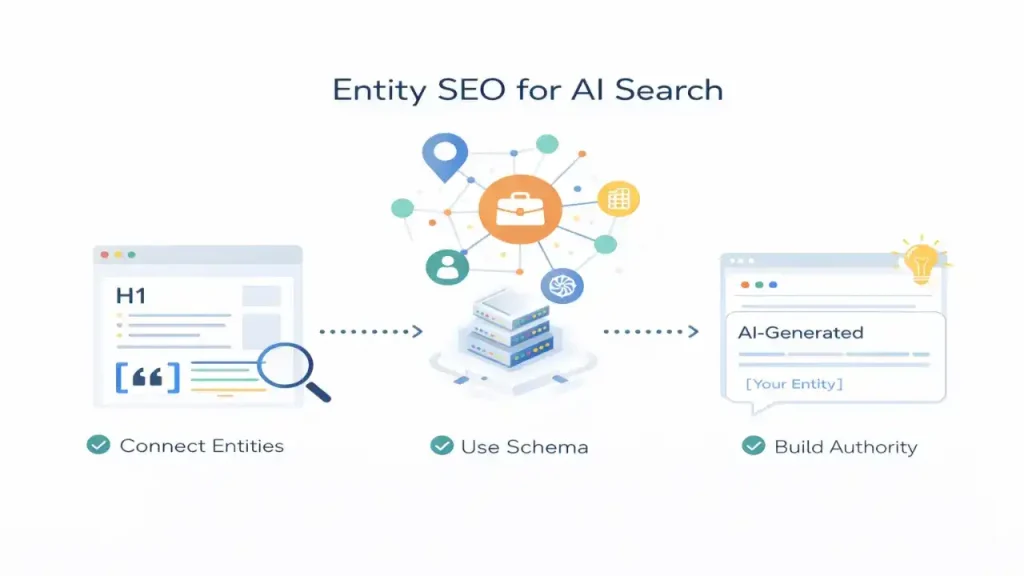
Entity SEO for AI Search is the practice of helping AI systems clearly understand who you are, what you cover, and why your content should be trusted—not just at the page level, but at the entity level. In AI-driven search and answer engines, entities matter more than keywords. Sites that are consistently recognized as authoritative entities are more likely to be used, summarized, and cited across AI Overviews, conversational AI, and citation-based engines.
This guide explains how entity understanding works in AI search, how to build entity authority systematically, and how Entity SEO fits into a complete Generative Engine Optimization (GEO) framework.
What Is an Entity in AI Search?
An entity is a uniquely identifiable thing with attributes and relationships. In AI search, entities commonly include:
- Brands and organizations
- People and authors
- Products and technologies
- Concepts and topics
AI systems do not evaluate pages in isolation. They evaluate entities and their relationships, then decide which sources are trustworthy enough to reuse in generated answers.
How AI Systems Understand Entities
Entity Recognition
AI models detect and classify entities mentioned in content:
- Names
- Topics
- Technologies
- Brands
Clear, consistent naming helps systems avoid ambiguity.
Entity Relationships
AI connects entities through relationships such as:
- Brand → topic expertise
- Author → subject authority
- Page → canonical explanation
- Topic → subtopics
The stronger and more consistent these relationships are, the easier it is for AI to trust your content.
Entity Consolidation
When multiple pages, signals, and mentions point to the same entity consistently, AI systems consolidate them into a single, stronger representation.
Fragmentation weakens this process.
Why Entity SEO Is Critical for AI Search
Traditional SEO can still succeed with:
- Good keywords
- Backlinks
- On-page optimization
AI search adds a requirement:
The system must understand and trust the source itself.
Entity SEO:
- Reduces citation inconsistency
- Increases reuse across AI answers
- Improves topical authority signals
- Supports long-term visibility beyond rankings
This is why Entity SEO is a foundational layer for LLMO, ChatGPT citations, and Perplexity optimization.
Core Components of Entity SEO for AI Search
1) Clear Entity Definition
Your site should clearly state:
- Who you are
- What topics you specialize in
- Who the content is for
This information should be consistent across:
- About pages
- Author bios
- Pillar content
- Internal linking
2) Canonical Topic Ownership
Each major topic should have:
- One primary pillar page
- Clearly defined supporting pages
- No competing explanations
This prevents AI systems from receiving mixed signals about which page represents your authoritative stance.
3) Consistent Terminology and Scope
Entity understanding improves when:
- Concepts are named consistently
- Definitions match across pages
- Scope does not drift unexpectedly
Avoid rebranding or renaming concepts without clear transitions.
4) Author and Expertise Signals
AI systems rely heavily on who is speaking.
Strengthen author-level entities by:
- Using real author names
- Including bios that explain expertise
- Maintaining consistent authorship across related topics
This supports both entity trust and citation accuracy.
Content Architecture That Strengthens Entities
Pillar-and-Cluster Structure
Entity SEO works best with:
- One pillar page defining the topic
- Supporting articles covering subtopics
- Clear internal linking back to the pillar
This architecture signals topical ownership.
Section-Level Independence
Each section should:
- Stand alone conceptually
- Define terms explicitly
- Avoid reliance on hidden context
AI systems often extract content at the section level, not the page level.
Entity Reinforcement Through Linking
Internal links reinforce entity relationships when they:
- Use descriptive anchors
- Point to canonical pages
- Follow a logical hierarchy
Avoid circular or excessive linking that dilutes focus.
Structured Data and Entity SEO
Structured data can help clarify entity relationships, but it is supportive, not decisive.
Best practices:
- Use schema that matches visible content
- Represent real entities only
- Keep data consistent across pages
Structured data strengthens clarity but cannot compensate for weak content or unclear entity definitions.
Entity SEO and AI Citations
AI systems prefer citing sources that:
- Represent a recognized entity
- Provide consistent explanations
- Demonstrate topical depth over time
Entity SEO increases the likelihood that:
- Your site is selected repeatedly
- Citations remain consistent across answers
- AI systems “remember” your site as a reference
This is especially important for citation-heavy engines like Perplexity.
Measuring Entity SEO Progress
Entity SEO progress appears gradually through:
- Broader query coverage
- More consistent phrasing reused in AI answers
- Increased impressions across related topics
- Higher-quality traffic from AI-driven sources
Unlike rankings, entity trust compounds over time.
Common Entity SEO Mistakes
- Publishing overlapping pages that compete for the same topic
- Inconsistent naming of concepts or entities
- Weak or generic author bios
- Mixing unrelated topics under one brand
- Treating entity SEO as a one-time setup
These errors fragment entity understanding.
How Entity SEO Fits Into the GEO System
Within a Generative Engine Optimization (GEO) strategy:
- GEO defines the system
- LLMO defines how content is written
- ChatGPT citation optimization ensures reuse
- llms.txt provides optional context
- Entity SEO establishes trust and identity
- Perplexity optimization amplifies citations
Each layer builds on the previous one.
Frequently Asked Questions
Is Entity SEO different from brand SEO?
Entity SEO includes brand SEO but extends beyond branding to cover authors, topics, and conceptual ownership.
Can small sites build strong entity signals?
Yes. Consistency, clarity, and topical focus matter more than size.
How long does entity SEO take to work?
Entity trust builds gradually. Early signals appear in impressions and reuse consistency before clear traffic growth.
Strong entity signals not only improve AI understanding but also influence citation-based platforms. Knowing how to rank in Perplexity depends heavily on clarity, authority, and consistent entity representation.
Final Thoughts
Entity SEO is the backbone of AI search visibility. As search moves from ranking pages to selecting trusted sources, sites that clearly define who they are and what they stand for will outperform those chasing isolated keywords.
When implemented as part of a full GEO and LLMO system, Entity SEO transforms your site from a collection of pages into a recognized authority—one that AI systems can safely rely on, summarize, and cite in the evolving search landscape.