Getting cited by ChatGPT is not about ranking first or adding special markup. It’s about publishing content that large language models can trust, extract accurately, and reuse without distortion. This guide explains how ChatGPT selects sources, what makes content citable, and how to structure pages so they are consistently referenced inside AI-generated answers.
This article is a core execution layer within the Generative Engine Optimization (GEO) system and builds directly on Large Language Model Optimization (LLMO) principles.
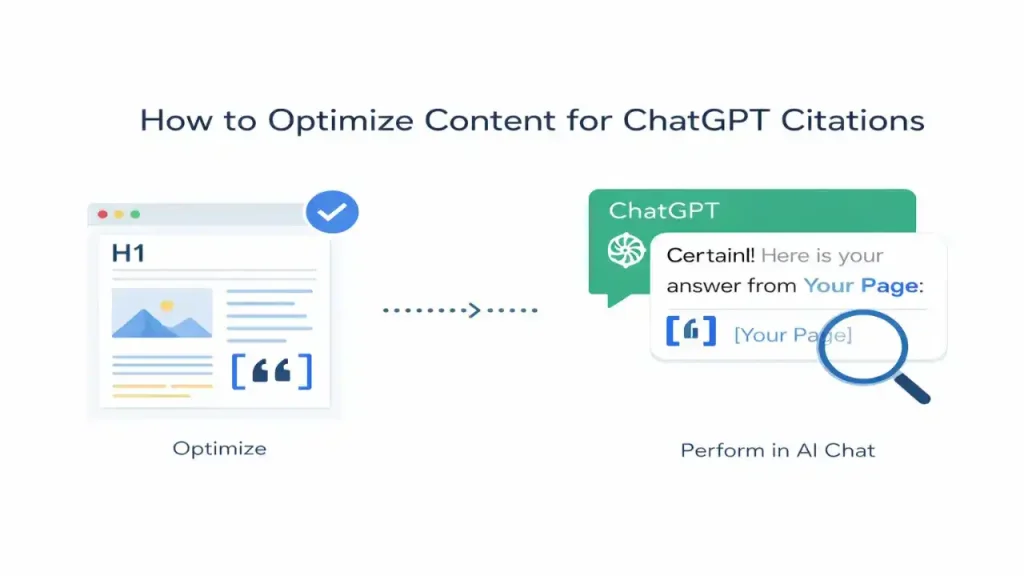
How ChatGPT Chooses Sources to Cite
ChatGPT generates answers by synthesizing information from multiple trusted sources. When citations are shown or implied, selection typically favors content that demonstrates:
- Clear definitions and explanations
- Factual accuracy with constraints
- Consistent terminology
- Recognizable topical authority
- Neutral, instructional tone
Pages that are vague, promotional, or internally inconsistent are less likely to be reused safely.
What Makes Content “Citable” by ChatGPT
Explicit Definitions
Citable content defines concepts clearly in one or two sentences before expanding.
Best practice:
Start sections with a direct definition that can stand alone without context.
Verifiable Statements
Facts, steps, and explanations should be:
- Specific
- Testable
- Free of exaggerated claims
When appropriate, distinguish between:
- What is generally true
- What depends on conditions
- What is opinion or recommendation
Neutral, Instructional Language
ChatGPT avoids marketing-heavy language when selecting sources.
Prefer:
- “This approach works when…”
- “A common limitation is…”
Avoid:
- “The best solution ever”
- “Guaranteed results”
Consistent Terminology
Use one primary term per concept and apply it consistently across the page and across related pages.
This reduces ambiguity during summarization and improves citation reliability.
Writing Patterns That Increase Citation Likelihood
Definition → Context → Constraints
This pattern mirrors how ChatGPT builds explanations:
- Define the concept
- Explain why it matters
- State limits or exceptions
Step-by-Step Instructions
Numbered steps with concise descriptions are easier for ChatGPT to reproduce accurately.
Each step should:
- Contain one action
- Avoid nested complexity
- Use plain language
FAQ-Based Coverage
FAQs align closely with conversational prompts.
Each FAQ answer should:
- Directly answer the question
- Stay under four sentences
- Avoid internal references like “as mentioned above”
Formatting for Safe Reuse by AI
Clear Section Boundaries
Use H2 and H3 headings that reflect real questions or tasks.
Each section should be understandable in isolation, as ChatGPT often extracts content at the section level.
Short, Focused Paragraphs
Dense blocks of text increase the risk of misinterpretation.
Aim for:
- One idea per paragraph
- Logical progression
- Minimal filler
Tables for Comparisons
Tables reduce ambiguity and help ChatGPT compare attributes accurately.
Use tables for:
- Feature differences
- Use-case comparisons
- Pros and cons
The Role of Entity Signals in ChatGPT Citations
ChatGPT relies heavily on entity understanding. To strengthen entity signals:
- Clearly state who the content is for
- Define the scope of your expertise
- Maintain consistent topical coverage across related pages
This is why Entity SEO for AI Search is a critical supporting layer within the GEO system.
Internal Linking That Supports Citations
Internal links help reinforce topical boundaries and authority.
Recommended structure:
- Link up to the Generative Engine Optimization (GEO) pillar for context
- Link to Large Language Model Optimization (LLMO) for conceptual grounding
- Avoid excessive lateral links that dilute page focus
Each link should serve reader intent, not link volume.
Technical Foundations That Matter
Crawlable, Text-First Content
Ensure that:
- Core explanations are visible in rendered HTML
- Key sections are not hidden behind scripts or gated UI elements
Canonical Clarity
One canonical page per concept improves trust and reduces conflicting signals.
Avoid publishing multiple pages that answer the same question differently.
Structured Data (Optional)
Structured data does not guarantee citation, but it can reinforce clarity when it matches visible content exactly.
Never include structured data that adds information not present on the page.
Measuring Citation Visibility
Citation visibility is not always directly measurable, but you can monitor indicators:
- Mentions or references in ChatGPT or similar tools
- Increased impressions for informational queries
- Higher engagement from AI-referred traffic
- Consistent reuse of phrasing across AI-generated answers
These signals should be evaluated alongside broader AI search visibility tracking.
Common Mistakes That Prevent Citations
- Vague explanations without constraints
- Mixing multiple intents on one page
- Overuse of persuasive or sales-driven language
- Inconsistent definitions across pages
- Lack of identifiable expertise or authorship
These issues increase hallucination risk and reduce trust.
Implementation Checklist
Before publishing or updating a page for ChatGPT citations, confirm:
- The main concept is defined clearly at the top
- Each section answers one question or task
- Terminology is consistent throughout
- Constraints and limits are stated
- Internal links reinforce topical authority
- Content is readable without external context
Frequently Asked Questions
Can any website be cited by ChatGPT?
In principle, yes—but content must be clear, accurate, and trustworthy enough to be reused safely.
Does ranking high in Google guarantee ChatGPT citations?
No. Rankings help discovery, but citation depends more on clarity, structure, and reliability.
Do I need special files or AI-specific markup?
No. High-quality, well-structured content and strong entity signals matter far more.
Final Thoughts
Optimizing for ChatGPT citations is about making your content safe to reuse. The clearer, more precise, and more constrained your explanations are, the more likely they are to be selected, summarized, and cited accurately.
When this approach is combined with LLMO principles and embedded within a full Generative Engine Optimization (GEO) system, your content moves from simply being indexed to becoming a trusted source inside AI-generated answers.