AI-readable content is content that AI systems can understand accurately, extract safely, and reuse without distortion. Writing this way doesn’t mean writing for machines instead of humans—it means writing with clarity, structure, and constraints so both humans and AI arrive at the same understanding.
This guide provides a practical writing framework you can apply to any page within a Generative Engine Optimization (GEO) system, supporting AI Overviews, LLM citations, and citation-first engines.
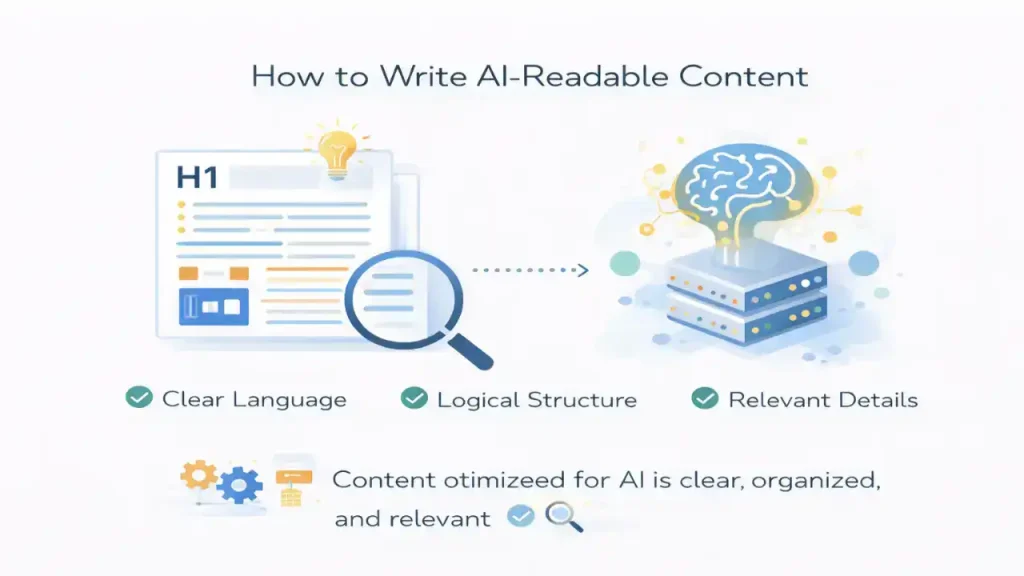
What Makes Content “AI-Readable”?
AI-readable content shares three traits:
- Clarity – the main idea is explicit and easy to identify
- Structure – information is organized so it can be extracted reliably
- Precision – statements are constrained, factual, and consistent
When these traits are present, AI systems can summarize and cite your content without guessing.
The Core Principles of AI-Readable Writing
1) Answer First, Explain Second
AI systems look for the answer immediately.
Best practice
- Open key sections with a 1–2 sentence answer
- Expand with context, examples, or steps afterward
Avoid long introductions that delay the answer.
2) One Idea Per Section
Each H2 or H3 should address one question or task.
Why it matters:
- AI often extracts content at the section level
- Mixed ideas increase misinterpretation risk
If a section answers two questions, split it.
3) Consistent Terminology
Choose one term per concept and use it consistently:
- Define it once
- Reuse the same wording
- Avoid unnecessary synonyms
Consistency improves comprehension and citation accuracy.
4) State Constraints Explicitly
High-quality AI-readable content explains:
- When advice applies
- When it does not
- Any assumptions or limits
This reduces hallucination risk and increases trust.
A Simple AI-Readable Writing Framework
Use this framework for most informational pages:
Definition
Start with a concise definition that can stand alone.
Context
Explain why the concept matters or when it’s used.
Steps or Explanation
Provide:
- Numbered steps for how-to content
- Bullet points for explanations
- Tables for comparisons
Constraints
Clarify edge cases, limits, or exceptions.
Summary (Optional)
End with a brief recap that restates the core idea.
Formatting Techniques That Improve Extractability
Clear Headings
Use headings that mirror real user questions.
Short Paragraphs
- 2–4 sentences per paragraph
- One idea per paragraph
Lists and Tables
Lists and tables reduce ambiguity and are easier to summarize accurately.
Minimal Cross-References
Avoid phrases like “as mentioned earlier.” Each section should be understandable on its own.
Writing for AI Without Losing Human Value
AI-readable does not mean robotic.
To keep content human-friendly:
- Use plain language
- Avoid jargon unless defined
- Keep tone neutral and instructional
- Use examples where helpful
Human clarity improves AI clarity.
Common Writing Patterns That Fail in AI Search
- Vague introductions with no direct answer
- Overly clever or metaphor-heavy language
- Long narratives before actionable information
- Inconsistent naming of the same concept
- Mixing opinion and fact without distinction
These patterns confuse both readers and AI systems.
Internal Linking That Supports AI-Readable Content
Internal links should reinforce context—not distract.
Recommended links:
- Link up to Generative Engine Optimization (GEO) for strategic context
- Link to Large Language Model Optimization (LLMO) for model behavior
- Link to ChatGPT Citations Optimization when citation reuse is relevant
Use descriptive anchors that reflect the linked page’s role.
Technical Considerations for Readability
Visible Text Matters
Ensure core explanations are:
- Visible in rendered HTML
- Not hidden behind scripts or collapsible UI by default
Canonical Pages
Maintain one canonical page per concept to avoid conflicting explanations.
Measuring Whether Content Is AI-Readable
AI-readability shows up indirectly:
- Broader query coverage in Search Console
- More impressions for informational queries
- Consistent phrasing reused in AI answers
- Higher engagement from AI-referred traffic
Measurement is covered in the AI Search Visibility Tracking guide.
AI-Readable Content Checklist
Before publishing, confirm:
- The main answer appears early
- Each section covers one idea
- Terminology is consistent
- Constraints are stated
- Structure supports extraction
- Internal links reinforce topical hierarchy
If all boxes are checked, your content is AI-readable.
Frequently Asked Questions
Is AI-readable content only for AI search?
No. It improves human comprehension and traditional SEO as well.
Does AI-readable writing require special tools?
No. It’s a writing discipline, not a software feature.
Can AI-readable content rank normally in Google?
Yes. Clear, structured content aligns with SEO best practices.
Final Thoughts
Writing AI-readable content is about removing ambiguity. When your explanations are clear, structured, and constrained, AI systems can reuse them confidently—and humans can understand them faster.
Within a complete GEO content system, AI-readable writing is the connective tissue that allows:
- AI Overviews to summarize accurately
- LLMs to cite reliably
- Citation-first engines to trust your pages
Clarity is the advantage.