Choosing the right AI productivity tool can be challenging with so many options available. An effective AI productivity tools comparison focuses on real functionality, use cases, and value rather than hype. The goal is to understand how different categories of AI tools perform and which ones best fit specific productivity needs.
This comparison guide breaks down AI productivity tools by purpose, strengths, and ideal users to help you make informed decisions.
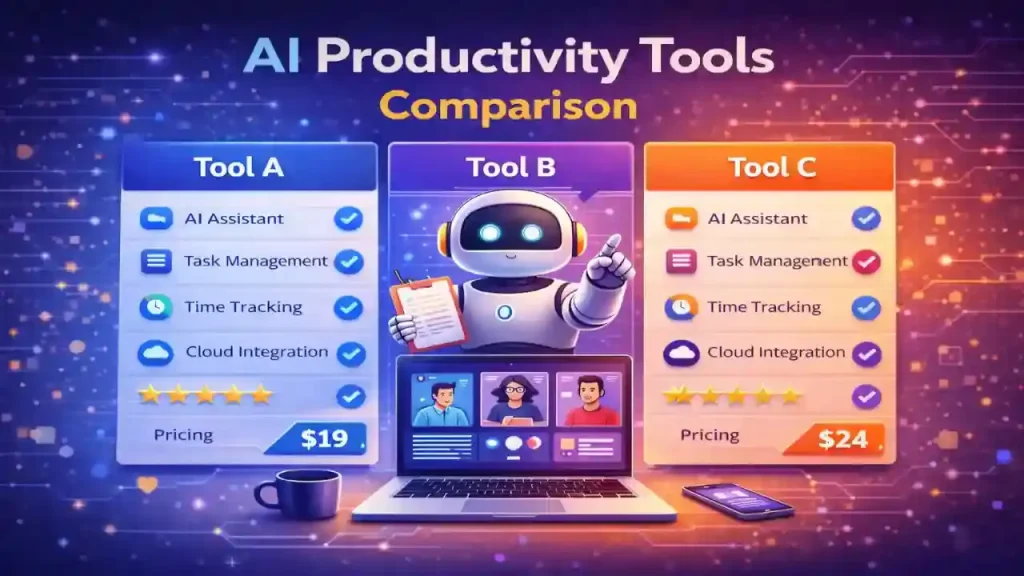
What Is an AI Productivity Tools Comparison?
An AI productivity tools comparison evaluates different AI-powered solutions based on how they improve efficiency, automate tasks, manage time, and support workflows. Instead of focusing on individual brand names, this approach compares tools by category and function to provide long-term value.
Key comparison factors include:
- Core functionality
- Ease of use
- Automation capabilities
- Integration flexibility
- Scalability
This method ensures the comparison remains relevant as tools evolve.
Key Criteria for Comparing AI Productivity Tools
Before comparing tools, it is important to define evaluation criteria.
Productivity Impact
How much time and effort does the tool actually save in daily workflows?
Automation Level
Does the tool automate tasks fully or only assist partially?
Learning Curve
How easy is it to adopt and use the tool effectively?
Integration
Does the tool work well with existing platforms and workflows?
Reliability
Is the output consistent, accurate, and dependable?
AI Writing Tools vs Automation Tools
Different AI productivity tools serve different purposes.
AI Writing Tools
Best for:
- Content creation
- Email drafting
- Documentation
- Editing and rewriting
Strengths:
- Immediate productivity gains
- Easy adoption
- Strong support for communication-heavy work
Limitations:
- Limited workflow automation
- Requires human review
AI Automation Tools
Best for:
- Repetitive task automation
- Workflow management
- Cross-app integration
Strengths:
- Significant time savings
- Reduced manual workload
- Scalable automation
Limitations:
- Initial setup required
- May require workflow planning
AI Time Management Tools vs Task Management Tools
AI Time Management Tools
Focus on:
- Schedule optimization
- Task prioritization
- Focus improvement
Best for individuals who struggle with time allocation and workload balance.
AI Task and Project Management Tools
Focus on:
- Task tracking
- Project coordination
- Team collaboration
Best for teams and professionals managing multiple projects.
AI Tools for Individuals vs Teams
AI Productivity Tools for Individuals
Ideal for:
- Freelancers
- Students
- Solo professionals
They prioritize ease of use, personal productivity, and minimal setup.
AI Productivity Tools for Teams
Designed for:
- Remote teams
- Small businesses
- Collaborative projects
They emphasize coordination, shared workflows, and communication efficiency.
Free vs Paid AI Productivity Tools
Free AI Productivity Tools
Advantages:
- No cost
- Good for basic tasks
- Ideal for testing
Limitations:
- Feature restrictions
- Usage limits
- Limited customization
Paid AI Productivity Tools
Advantages:
- Advanced automation
- Better accuracy
- More integrations
- Professional support
Limitations:
- Ongoing cost
- Requires commitment
Paid tools generally offer better long-term productivity gains for professional use.
AI Productivity Tools for Specific Use Cases
For Students
AI tools focused on writing, summarization, and time management offer the most value.
For Freelancers
Automation, time tracking, and writing tools provide the biggest productivity boost.
For Small Businesses
Workflow automation, customer communication, and task management tools are most effective.
For Remote Work
Collaboration, scheduling, and communication-focused AI tools perform best.
Strengths and Weaknesses Across AI Productivity Tools
Common Strengths
- Time savings
- Reduced repetitive work
- Improved organization
- Better focus and efficiency
Common Weaknesses
- Requires quality input
- Human oversight still needed
- Setup time for automation
- Potential over-reliance
Understanding these trade-offs is essential when selecting tools.
How to Choose the Best AI Productivity Tool
Rather than choosing the most popular tool, select based on:
- Your primary productivity challenge
- Individual vs team needs
- Desired automation level
- Budget and scalability
- Privacy and data handling
The best AI productivity tool is the one that integrates smoothly into your daily workflow.
The Future of AI Productivity Tools
AI productivity tools are moving toward:
- Deeper personalization
- Smarter automation
- Unified productivity ecosystems
- Stronger privacy controls
Future tools will focus less on features and more on seamless productivity experiences.
Frequently Asked Questions
Are AI productivity tools better than traditional tools?
AI tools offer smarter automation and insights, while traditional tools rely on manual input. The best results often come from combining both.
Do AI productivity tools work for all industries?
Yes, but effectiveness depends on matching the tool to the workflow and industry needs.
Is it better to use one AI tool or multiple tools?
Using fewer, well-integrated tools usually delivers better productivity than managing many overlapping tools.
Beyond features and performance, pricing models play a major role in tool selection. Comparing free vs paid AI productivity tools clarifies which options deliver the best value for different needs.
Final Thoughts
An effective AI productivity tools comparison focuses on functionality, use cases, and real productivity impact rather than trends. By understanding how different categories of AI tools perform, you can choose solutions that genuinely improve efficiency and support long-term productivity.
This comparison article strengthens the overall AI tools for productivity content cluster by helping users move from exploration to confident decision-making.